Peyronie’s Disease Without Surgery: Can Penile Curvature Be Treated Without an Operation?
Peyronie’s disease causes scar tissue to form inside the penis. As a result, the penis may bend during an erection. Some men experience mild curvature. However, others develop pain, shortening, or difficulty during sexual intercourse.
The good news is that surgery is not necessary for every patient. In fact, several non-surgical Peyronie’s disease treatment options may help manage symptoms. These options include medication, penile traction therapy, and selected injection treatments.
However, each treatment has different benefits and limitations. Therefore, understanding the available options is important before choosing a treatment plan.
Can Peyronie’s Disease Be Treated Without Surgery?
Yes, some men can manage Peyronie’s disease without undergoing an operation. However, the most suitable approach depends on the disease stage, curvature severity, and erectile function.
For example, patients with pain during the active stage may benefit from pain management. Meanwhile, men with stable curvature may be considered for selected injection treatments or penile traction therapy.
Nevertheless, non-surgical treatments do not guarantee complete correction. In some cases, the main goal is to reduce pain or prevent further functional problems rather than restore the original penile shape.
Therefore, a specialist should assess the condition before recommending any treatment.
What Are the Non-Surgical Treatment Options for Peyronie’s Disease?
Several treatment approaches are available. However, their effectiveness varies depending on the patient’s condition and the available clinical evidence.
1. Medication for Peyronie’s Disease
Medication may help manage certain symptoms associated with Peyronie’s disease. For instance, doctors may recommend non-steroidal anti-inflammatory drugs (NSAIDs) to relieve pain during the active stage.
However, these medications do not remove scar tissue or reliably straighten the penis. Therefore, patients should not expect pain medication alone to correct penile curvature.
In addition, men who experience erectile dysfunction may benefit from specific medications prescribed by their doctor. These treatments address erectile function rather than directly correcting the plaque.
2. Penile Traction Therapy
Penile traction therapy is a non-surgical approach that uses a medical device to apply controlled stretching to the penis.
The device applies gentle tension over a recommended period. As a result, it may help improve penile curvature or preserve penile length in selected patients.
However, treatment requires consistency and patience. Some devices also require extended daily use. Therefore, the specialist should explain the correct technique and recommended duration.
Furthermore, clinical evidence is still limited. Although some studies report improvements, results vary between patients.
3. Injection Therapy for Peyronie’s Disease
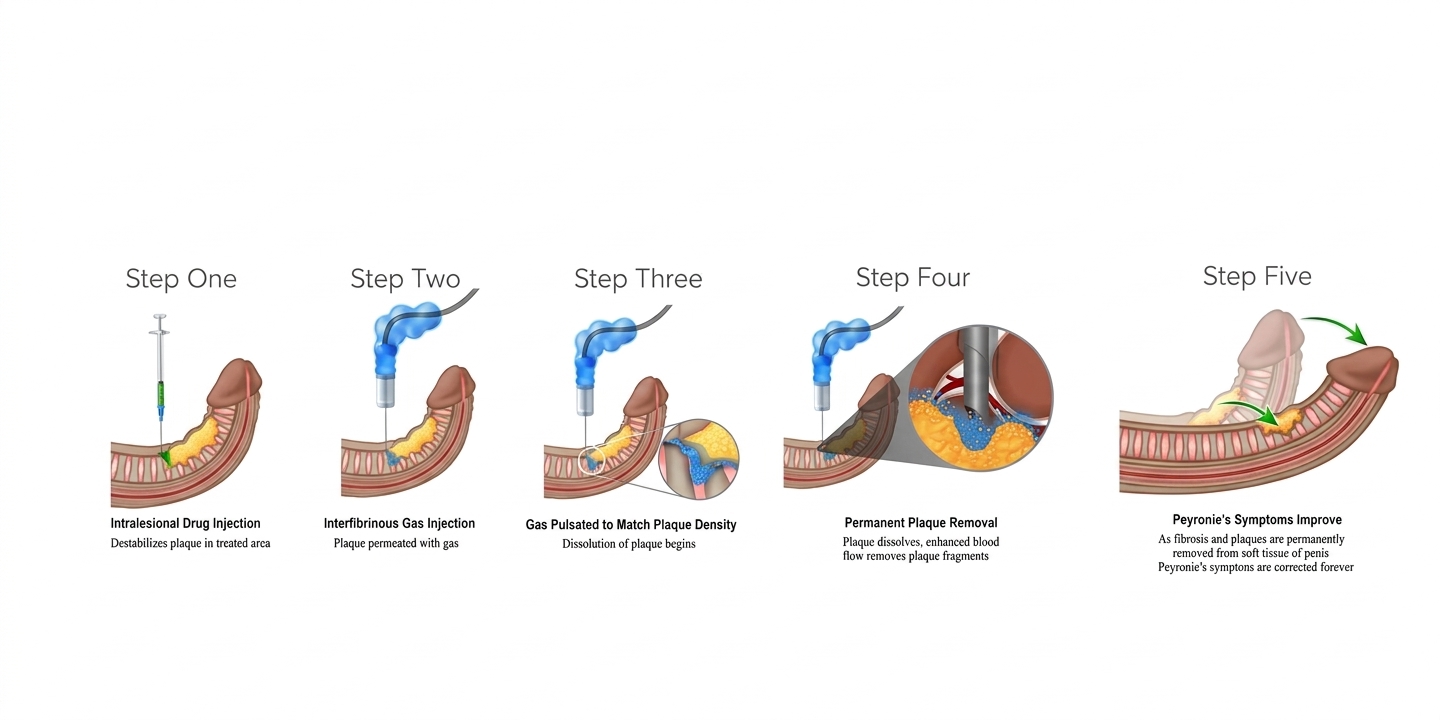
Injection therapy involves delivering medication directly into the scar tissue. This approach may be suitable for selected patients, particularly those with stable disease and specific curvature patterns.
One treatment option is collagenase clostridium histolyticum. This enzyme targets collagen within the plaque and may help reduce penile curvature.
However, it is not suitable for every patient. Doctors consider plaque location, curvature severity, disease stability, and treatment availability before recommending it.
In addition, injection therapy may cause bruising, swelling, pain, or other complications. Therefore, it must only be performed by an appropriately trained specialist.
Important: Availability of collagenase treatment differs between countries. Consequently, patients should ask their specialist which approved treatment options are currently available in their location.
4. Shockwave Therapy
Shockwave therapy uses focused sound waves applied to penile tissue. Some patients consider it because they want to avoid surgery.
However, clinical evidence shows that shockwave therapy may help reduce penile pain without reliably improving curvature or reducing plaque size.
Therefore, current European guidelines do not recommend shockwave therapy as a treatment for correcting penile curvature.
Instead, doctors may consider it for pain management in selected patients during the active stage.
5. Vacuum Erection Devices
A vacuum erection device uses negative pressure to draw blood into the penis. It is commonly used to help achieve an erection.
In addition, some doctors may consider vacuum devices as part of a conservative treatment approach for Peyronie’s disease.
However, evidence regarding their ability to correct penile curvature remains limited. Therefore, patients should discuss their suitability with a specialist before using one.
Does Treatment Depend on the Stage of Peyronie’s Disease?
Yes, the stage of the condition plays an important role in treatment selection. Generally, doctors distinguish between the active and stable stages.
Active Stage of Peyronie’s Disease
During the active stage, penile curvature may continue to change. Moreover, patients may experience pain during erections.
At this point, treatment often focuses on controlling pain and monitoring the condition. For example, doctors may recommend anti-inflammatory medication when appropriate.
In addition, selected patients may benefit from conservative approaches under medical supervision.
Stable Stage of Peyronie’s Disease
During the stable stage, penile curvature stops progressing. Furthermore, pain often decreases or disappears.
At this stage, doctors can assess the remaining deformity more accurately. Consequently, they can discuss whether observation, injection therapy, traction, or surgery is appropriate.
However, stable disease does not automatically mean that surgery is necessary. The decision depends on how much the curvature affects sexual function and quality of life.
Can Penile Traction Correct Curvature Completely?
Penile traction therapy may improve curvature in some patients. However, complete correction cannot be guaranteed.
The results depend on several factors, including the degree of curvature, treatment duration, device type, and patient adherence.
Furthermore, traction devices are not suitable for everyone. Patients should receive professional instructions before starting treatment.
Therefore, it is important to discuss realistic expectations with a specialist.
Can Peyronie’s Disease Improve Without Treatment?
Some symptoms may improve naturally over time. For example, pain during erections often decreases as the disease becomes stable.
However, penile curvature may remain even after the pain disappears. In some cases, the deformity may continue to affect sexual intercourse.
Therefore, improvement in pain does not necessarily mean that the condition has completely resolved.
A specialist can assess whether monitoring is sufficient or whether additional treatment may be helpful.
When Is Surgery Still Necessary?
Non-surgical treatment may be suitable for many patients. Nevertheless, some men continue to experience significant penile curvature that interferes with sexual intercourse.
In these cases, surgery may become an option.
Doctors generally consider surgery when the disease is stable and the deformity causes functional problems. Moreover, they assess penile length and erectile function before selecting a procedure.
Surgical options may include penile plication, plaque incision and grafting, or penile implant surgery in selected patients with erectile dysfunction.
For more information, read our article about Peyronie’s Disease Surgery: When Is Surgery Necessary?
How Can You Choose the Right Non-Surgical Treatment?
Choosing a treatment requires an individual medical assessment. Therefore, patients should not select a device, medication, or injection based only on online recommendations.
During the consultation, the specialist may evaluate:
- The degree and direction of penile curvature.
- Whether the disease is active or stable.
- The presence of pain during erections.
- Penile length and any visible deformity.
- Erectile function.
- Previous treatments and medical history.
In addition, the doctor may recommend an ultrasound or other assessment when clinically appropriate.
This evaluation helps identify the most suitable treatment and avoid unnecessary procedures.
Frequently Asked Questions About Peyronie’s Disease Without Surgery
1. Can Peyronie’s Disease Be Cured Without Surgery?
Some patients can manage their symptoms without surgery. However, complete correction of penile curvature is not guaranteed. Therefore, treatment depends on the severity and stage of the condition.
2. Does Penile Traction Therapy Really Work?
Penile traction therapy may improve curvature or help preserve penile length in selected patients. However, results vary, and further research is needed to establish its effectiveness.
3. Can Medication Remove Peyronie’s Disease Plaque?
No medication has been proven to reliably remove Peyronie’s disease plaque. Instead, some medications help manage pain or treat associated erectile dysfunction.
4. Does Shockwave Therapy Straighten the Penis?
No, current evidence does not show that shockwave therapy reliably corrects penile curvature. However, it may help reduce pain in some patients.
5. Are Injections an Alternative to Surgery?
Yes, selected injection treatments may help reduce curvature in suitable patients. However, the results depend on the type of injection, plaque characteristics, and disease stage.
6. When Should I Consider Surgery?
Surgery may be considered when the disease is stable and penile curvature significantly interferes with sexual intercourse. Nevertheless, the specialist must assess your condition before recommending an operation.
Conclusion
Peyronie’s disease does not always require surgery. Several non-surgical approaches may help manage symptoms, including medication, penile traction therapy, selected injections, and other conservative treatments.
However, each option has limitations, and treatment results vary between patients. Therefore, consulting an experienced specialist is essential before choosing a treatment plan.
With an accurate diagnosis and appropriate medical guidance, patients can understand their options and make informed decisions about their sexual health.



Leave a Reply
You must be logged in to post a comment.